Dots and Boxes Chains
Learn what a chain really is, how it takes shape before the endgame, why one opened box can release several more, and how to spot the structure before you are forced to give it away.
A chain in Dots and Boxes is not simply a row of squares. It is a connected sequence of unclaimed boxes that can become linked by the game’s extra-turn rule: once one box in the sequence is made available, completing it can expose the next, then the next, until several boxes are captured in the same turn.
This is why a quiet-looking position can change so quickly. Early in the game, players mostly think about individual lines and individual boxes. Later, the board begins to behave in groups. A single move may no longer be worth one square; it may decide who receives an entire chain.
This guide stays focused on that structure itself: how chains form, how to identify them, how chain length changes their importance, and what happens when one is opened. Broader winning strategy belongs in our guide to winning Dots and Boxes, while the rules behind scoring and extra turns are covered separately in the Dots and Boxes rules.
What Is a Chain in Dots and Boxes?
A chain is a path of adjacent unclaimed boxes whose remaining open sides connect their fates. When the position is sufficiently developed, opening one end of that path allows the other player to complete a box and keep moving through the same connected sequence.
The important word is sequence. A chain has an order. One box leads into another. In mathematical descriptions of Dots and Boxes, a chain containing N boxes is often called an N-chain. A chain of four boxes is therefore a 4-chain, a chain of five boxes is a 5-chain, and so on.
The boxes do not have to sit in a perfectly straight horizontal or vertical line. A chain can turn a corner. What matters is the way the unclaimed boxes are connected through the edges that remain available, not the visual shape they make on the page.
If opening one box creates a forced route through a connected sequence of boxes, you are looking at chain structure rather than a set of unrelated scoring chances.
The Anatomy of a Four-Box Chain
Consider four unclaimed boxes connected end to end. Before the chain is opened, none of them is free to take. The position is stable only because one or more boundary edges are still missing.
Once a player is forced to add the edge that exposes the first box, the other player can complete it. Completing that box earns another move. The capture may then expose the next box, allowing the same player to continue along the path.
This repeated extra move is what gives a chain its practical force. Without the rule that a completed box lets the same player move again, the boxes would not cascade in the same way.
Chains Are Formed Before They Are Captured
One of the most useful changes in how you see Dots and Boxes is to stop thinking of chains as something that suddenly appears at the end. The visible capture comes late; the structure is usually created much earlier.
During the safer part of a game, players try to avoid drawing the third side of an unclaimed box. A third side is dangerous because it leaves that box one line away from completion. As safe choices disappear, groups of boxes become tied together by the lines that are still missing.
Eventually the board may reach a point where there is no neutral move left. Any new line must give something away. When that happens, the important question is no longer simply, “Which box am I sacrificing?” It becomes, “Which connected group am I opening?”
That distinction matters because good chain reading starts before a chain has been handed over. If you wait until boxes are already being taken, the strategic decision that created the chain may have happened several moves earlier.
Why One Open Box Can Release the Rest of the Chain
Suppose your opponent opens one end of a four-box chain. You complete the first box. Because you scored, you move again. The line used to complete that box may leave the neighboring box with three sides, so you can complete that one too. The same pattern can repeat until the chain is exhausted or you deliberately choose another option.
This is why chain size matters more than the value of one isolated box. Giving away a single box can sometimes mean giving away every box connected behind it.
Short Chains and Long Chains Are Strategically Different
Chain length is counted by the number of boxes in the sequence. In formal Dots and Boxes endgame work, a long chain means a chain of at least three boxes.
That three-box threshold is important because longer chains create control choices that do not exist in the same way for tiny components. It is also why experienced players pay special attention to 3-chains and larger structures when the board is beginning to close.
They can still cost points, but they do not have the same strategic role as a long chain in standard endgame analysis.
These are the components that become central to advanced questions about sacrifice, control, and endgame value.
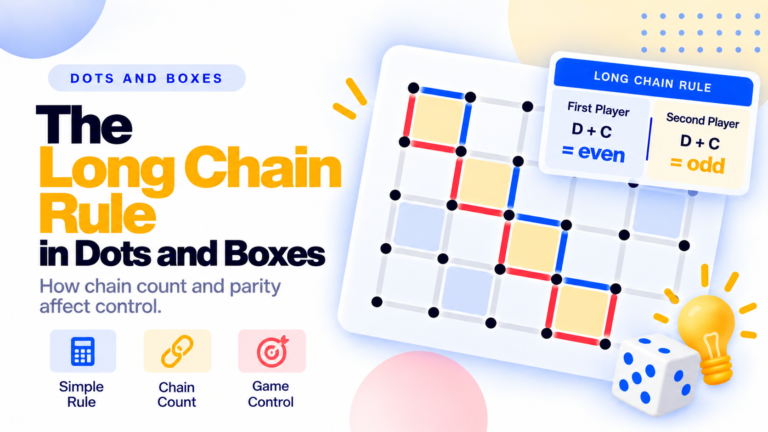
This article does not use “long chain” as a synonym for “any chain that looks big.” It uses the established three-or-more-box threshold. That keeps later strategy ideas precise and prevents a two-box giveaway from being confused with a true long-chain position.
How to Recognize a Chain on the Board
The easiest time to misread a chain is before any boxes in it have been captured. The board is crowded with lines, and the connected path may not look obvious. A reliable way to inspect the position is to ignore ownership for a moment and look only at the unclaimed boxes and their remaining open edges.
- Find the unclaimed boxes. Already completed boxes are no longer part of the future chain.
- Trace which unclaimed boxes still connect to one another. Follow the open edges that would allow a capture to lead into another box.
- Look for a path rather than a cluster. A simple chain has a sequence with ends. If the component branches, it is more complicated than an ordinary chain.
- Count the boxes in that path. The count tells you whether you are looking at a 2-chain, 3-chain, 4-chain, and so on.
- Ask what happens if one end is opened. If the opponent can complete one box and then continue through the sequence, the chain is strategically live.
Four boxes sitting next to one another are not automatically a 4-chain. Their remaining edges must create the connected capture path that makes one box lead into the next.
Not Every Group of Boxes Is a Chain
Beginners often count any nearby boxes as one chain. That can produce the wrong reading of the board.
A straight row may be broken into two separate components by a completed edge. A bent shape may still be one chain if its open path remains continuous. A branching component can contain several possible directions and therefore cannot be treated like a simple chain without further analysis. A closed route with no ordinary ends is a loop, which behaves differently enough to deserve separate treatment.
The practical lesson is simple: count connections, not proximity.
A Worked Example: What a 4-Chain Really Gives Away
Imagine the only relevant unclaimed component left on one part of the board is a 4-chain. You have no safe move elsewhere, so you must play into that component.
Your move does not score. Instead, it leaves the first box ready for your opponent.
Because a box was completed, the opponent keeps the turn.
Each completion can expose the next box in the sequence.
The important loss was control of a four-box component.
In an ordinary capture sequence, the opponent can take the chain. In advanced endgames, however, a player may sometimes choose not to take every available box because leaving part of a chain can preserve control of what comes next. That is a separate tactical decision; the key point here is that the chain creates the choice.
What Does It Mean to “Open” a Chain?
To open a chain is to make the move that gives the other player access to its capture sequence. In advanced mathematical descriptions, the player who must choose a chain or loop to open is often called the opener.
The player receiving the opened component may then face a different question: take all available boxes, or use a control-preserving sacrifice when the rest of the position justifies it. That player is often described as the controller in endgame analysis.
These terms are useful because they describe roles in a position, not permanent identities. The same player can be opener at one moment and controller later. Also, opening the first long chain is not an automatic declaration that the whole game is lost: the current score and the rest of the board still matter.
Five Common Mistakes When Reading Chains
A 4-chain means four boxes in the chain. It does not mean four remaining edges.
A chain may turn. Connectivity is what matters.
By then, the structure may already be fixed. Stronger reading starts while the component is still unopened.
Branches and loops can behave differently and should not be counted as ordinary chains without checking their shape.
That is often natural, but advanced endgames can make control more valuable than immediately collecting every available box.
A Simple Way to Practice Seeing Chains
You can improve chain recognition without memorizing a large amount of theory. Play on a small board and pause before the first obviously forced giveaway. Do not continue immediately. Instead, inspect the remaining unclaimed boxes as connected components.
- Circle each connected group of unclaimed boxes.
- Trace the path through each group.
- Count how many boxes belong to each simple chain.
- Predict which box becomes available first if one end is opened.
- Resume play and check whether your predicted capture route was correct.
If you prefer working on paper, use one of the printable Dots and Boxes grids and mark the chain paths after each practice game. The goal is not to calculate the entire endgame. It is to become faster at seeing where one box leads into another.
Why Understanding Chains Changes the Game
The first strategic lesson in Dots and Boxes is usually “do not give away a box.” Chains reveal why that advice eventually becomes too small.
A move can give away more than the square directly beside it. It can open a path through three, four, five, or more boxes because every capture creates another move. Once you start seeing those paths before they open, the board stops looking like a collection of isolated squares and starts looking like a set of connected components with different values and risks.
That is the foundation needed for later ideas such as endgame control, deliberate sacrifices, loops, and the long-chain rule. Those concepts add new decisions, but they all depend on first being able to identify the chain correctly.
The best way to make that recognition automatic is to play Dots and Boxes online, pause when the safe moves begin to disappear, and trace the unclaimed boxes before you draw the next line.