The Mathematics of Dots and Boxes
Behind the paper grid is a graph, a scoring system, a parity problem, and a surprisingly difficult game-theory problem. Several mathematical viewpoints explain different parts of what happens on the same board.
Dots and Boxes begins with one of the simplest rule sets a mathematical game can have: draw one unused edge, claim any box you complete, and move again after scoring. Yet those few rules produce positions that are studied with graph theory, combinatorial game theory, parity arguments, scoring values, and computational complexity.
No single mathematical idea explains the entire game.
Graph theory makes chains and loops easier to see. Parity helps explain why control can depend on whether certain counts are even or odd. Endgame values measure boxes rather than merely moves. A related normal-play game called Nimstring connects parts of Dots and Boxes with classical combinatorial game theory. Complexity theory explains why a universal shortcut for arbitrary positions is unlikely to be simple.
The useful way to study the game is therefore to change mathematical lenses when the question changes.
What Mathematics Is Actually Used in Dots and Boxes?
Different mathematical tools answer different questions.
Replace boxes and undrawn sides with vertices and edges. Chains, loops, and component structure become much easier to analyze.
Even and odd counts can determine which player receives favorable move order in suitable chain-based positions.
Endgame mathematics measures score margins and the cost of preserving control across different components.
Generalized Dots and Boxes is computationally difficult even though its move rules are simple.
These viewpoints overlap, but they are not interchangeable. A parity result may tell you something about move order without giving the final score. A graph can reveal a chain without telling you whether keeping control is worth its cost.
Strings-and-Coins Turns the Board Into a Graph
One of the most important mathematical representations of Dots and Boxes is its dual graph, traditionally called Strings-and-Coins.
Instead of looking at dots and squares, imagine one coin for every unclaimed box.
Whenever two neighboring boxes share an undrawn side, connect their two coins with a string. If an undrawn side lies on the outer boundary of the board, connect that box’s coin to a special outside object called the ground.
The two drawings describe the same playable information from different viewpoints. Drawing an unused box edge on the normal board corresponds to removing an edge from the dual graph.
Strings-and-Coins is also more general than ordinary Dots and Boxes. Arbitrary graphs can contain structures that could never arise from a standard rectangular grid. The usual game is therefore a special graph family inside the larger Strings-and-Coins framework.
Chains and Loops Become Degree Patterns
In graph language, the degree or valence of a coin is the number of uncut strings still attached to it.
That has a direct interpretation on the normal board.
This makes late-game structure much clearer.
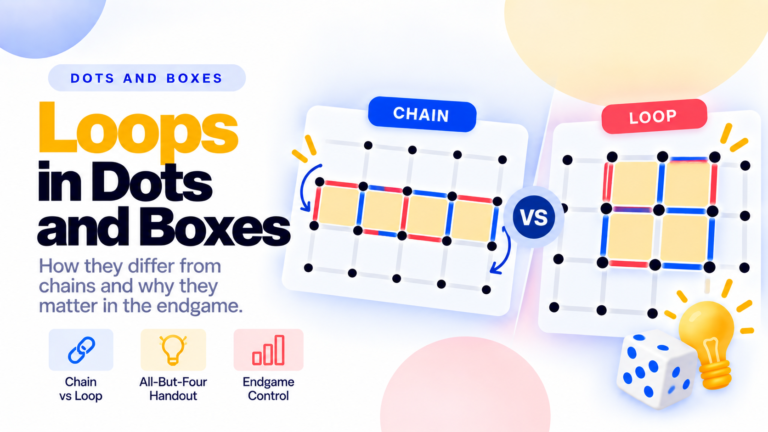
In the simple endgames studied mathematically, long sequences of degree-two coins form chains. Degree-two coins arranged in a closed cycle form loops. What looked like a complicated collection of nearly completed squares on the board becomes a collection of paths and cycles in the graph.
This graph viewpoint explains why chain and loop structure is more fundamental than the visual direction in which the boxes happen to run. A chain can bend repeatedly and still be the same type of mathematical component.
The playing consequences of those structures are covered separately in our articles on chains and loops.
Dots and Boxes Is Not an Ordinary Nim-Type Game
Classical Sprague-Grundy theory is designed for impartial normal-play games: both players have the same legal moves, separate components behave independently, and the player who makes the final move wins.
Dots and Boxes does not fit that model cleanly.
Either player can draw any currently unused legal edge.
The winner is determined by boxes scored, not simply by who makes the last move.
Completing a box gives the same player another move.
Extra turns can connect the strategic effect of components through move order.
This mismatch is exactly what makes the mathematical treatment interesting.
A related game called Nimstring changes the objective to normal play so that classical impartial-game tools can be brought into the picture. The score from captured coins is ignored; what matters is the normal-play outcome of the string-cutting game.
Who finishes with more boxes?
Who is left without a move?
Sprague-Grundy theory assigns normal-play impartial positions a number called a nimber. Independent components can then be combined using the bitwise exclusive-or operation, usually written XOR.
Berlekamp showed that nim-like reasoning can reveal important information inside Dots and Boxes, particularly about control and forced openings. But the scoring game and the normal-play abstraction are not identical. Later endgame work shows positions where knowing the Nimstring outcome is not enough to determine the optimal Dots and Boxes score.
Parity and Score Value Are Not the Same Thing
Dots and Boxes strategy often involves even and odd counts, but parity alone does not tell you how many boxes a player will win.
A parity calculation usually tracks move order. It can help determine which player is likely to become the opener when a chain phase begins.
A value calculation tracks score margin.
Describes the parity of moves, chains, or related counts.
Main question: who is forced to move?Measures how many more boxes one role can obtain than the other.
Main question: by how many boxes?The long chain rule is an example of a parity-based tool. It helps describe which chain-count parity favors which player in a suitable elementary setting.
Endgame value goes further because chains of different lengths and loops of different lengths do not contribute the same score.
Controlled Value Puts a Number on Endgame Control
For a simple endgame made from long chains and even loops, mathematicians can assign a quantity called the controlled value.
The idea begins with the score cost of keeping control.
Under sustained control, the controller takes all but two and gives two away.
Under sustained control, the controller takes all but four and gives four away.
Those net margins explain the characteristic subtraction of 4 for every long chain and 8 for every loop.
The terminal bonus corrects for the fact that control does not need to be preserved after the final useful handout. The last suitable component can be taken more completely.
Controlled value is not merely decorative notation. In important classes of simple loony endgames, it can determine the actual optimal value directly.
Example: A 5-Chain, a 6-Chain, and an 8-Loop
Consider an endgame containing exactly three components:
There are 19 unclaimed boxes in total, two long chains, and one loop.
Because the position contains chains of length at least four, its terminal bonus in the standard simple-endgame formula is 4.
For the simple loony endgame theorem, a controlled value of at least 2 is especially informative: the optimal game value equals the controlled value. In this example, the value is therefore 7.
Interpreted in the theorem’s standard tied-entry setup, the controller can finish this endgame seven boxes ahead of the opener under optimal play.
This is a deeper statement than saying “the controller has the better position.” Mathematics turns that positional advantage into an exact score margin for the defined endgame.
The practical decisions behind controller and opener roles are covered in the endgame strategy guide; here, the purpose is to show where their numerical values come from.
Why There Is No Small Formula for Every Position
The chain and loop formulas can make certain endgames look almost mechanical. That should not be mistaken for a complete solution to arbitrary Dots and Boxes.
In 2021, Kevin Buchin, Mart Hagedoorn, Irina Kostitsyna, and Max van Mulken proved that generalized Dots and Boxes is PSPACE-complete.
This does not mean that every ordinary Dots and Boxes position is impossible to analyze, that a small board cannot be solved, or that a computer must always use enormous memory.
Complexity classifications describe how the general problem scales. A fixed small board is still a finite game. Special endgames can have elegant formulas. Certain families of positions can be reduced dramatically by mathematical structure.
The important conclusion is narrower: there is no reason to expect one elementary rule such as parity, chain count, or controlled value to solve every possible position.
Strings-and-Coins and Nimstring have their own strong complexity results as well. This is another sign that the difficulty is not simply caused by the visual square grid. Much of it comes from the underlying graph and move-order structure.
What Each Mathematical Viewpoint Explains Best
That layered view is the main mathematical lesson of Dots and Boxes. A position can be simple under one lens and difficult under another.
A chain can be obvious as a graph component but difficult to value correctly. A parity count can identify favorable move order without telling you the final score. A clean endgame formula can solve a narrow component class even though the generalized game remains computationally hard.
If you want to see those ideas emerge naturally rather than only as formulas, play Dots and Boxes online and watch the board change from a grid of isolated choices into a graph of connected endgame components.