Dots and Boxes Opening Strategy
A good opening is not about finding one magical first line. It is about knowing which edges are still safe, checking both boxes beside a move, and seeing when the board is about to stop giving you harmless choices.
On an empty Dots and Boxes board, every legal first move is safe. No box already has two sides, so your first line cannot create a three-sided box for your opponent to capture.
The opening becomes strategic a few turns later. Lines begin to interact. Some boxes already have one side, others have two, and a move through the middle of the board can affect two boxes at once. At that point, choosing an edge without checking what it touches is how an apparently harmless opening turns into an early giveaway.
The main opening skill is therefore not memorizing a starting pattern. It is evaluating each candidate line correctly. A strong opening move keeps every adjacent unclaimed box below three sides while preserving awareness of the structures that are beginning to form.
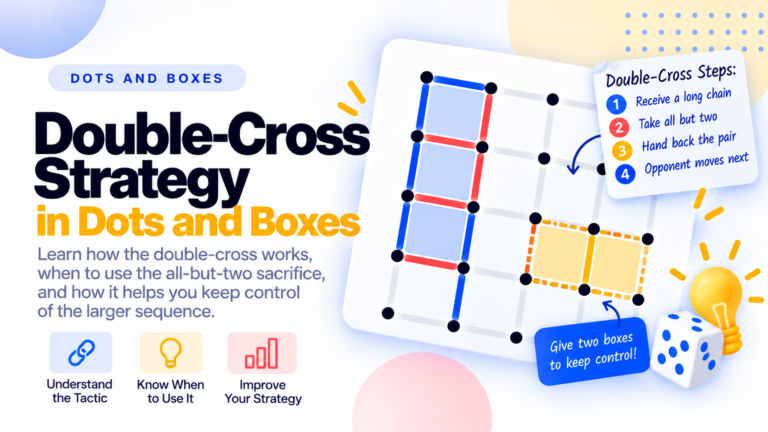
This guide stays within that early phase. It does not cover double-crosses, chain parity, loop control, or full endgame calculation. Those decisions happen after the board has moved beyond ordinary safe play.
The Opening Is a Fight Over Safe Moves
In the early game, the score is often still 0–0. That does not mean nothing important is happening.
Each line removes one available edge from the board and changes the side count of every box touching that edge. As the grid fills, the number of moves that can be played without creating an immediately capturable box gradually shrinks.
Call a move safe when drawing that edge does not leave any adjacent unclaimed box with exactly three completed sides.
If any adjacent box already has two sides, adding the candidate edge gives that box a third side and makes it available for your opponent to complete.
This is more precise than the familiar advice to “avoid the third side.” It tells you exactly what has to be inspected before a move is made.
The Side-Count Test for Any Opening Move
Choose an unused edge and look at the box or boxes beside it. Count how many sides each of those boxes already has.
For opening purposes, the critical transition is two sides to three.
Suppose a box already has its top and left edges. Adding its bottom edge does not score anything for you. Instead, it leaves the box with three sides. Your opponent can now draw the right edge, claim the box, and receive another move under the standard Dots and Boxes rules.
The move itself may look small. Its consequence is not: you have changed a box from neutral to immediately capturable without receiving a point in return.
One Edge Can Affect Two Boxes at the Same Time
A perimeter edge belongs to only one box. An interior edge is shared by two neighboring boxes.
That makes interior moves easy to misread.
You might inspect the box above a horizontal edge, see that it has only one side, and conclude that the move is safe. But if the box below that same edge already has two sides, the move creates a third side there.
An even stronger warning sign appears when both boxes beside an unused interior edge already have two sides. Drawing that one edge can leave two separate boxes with three sides at once.
This gives you a reliable opening habit: never judge an interior line from one side of the line. Check both adjacent boxes before committing.
Two Safe Moves Can Leave Very Different Boards
The side-count test tells you whether a move gives an immediate box away. It does not tell you that every safe move is strategically identical.
Consider two candidate edges. Both touch boxes that currently have only one side, so both pass the immediate safety test. After either move, those boxes will have two sides rather than three.
Yet the moves may alter different parts of the board. One can concentrate more two-sided boxes in a small area, while another changes a less-developed region. As later safe edges disappear, those arrangements can lead to different connected structures.
Changes a region with relatively few existing sides.
Adds another second side inside a more developed part of the board.
This does not create a universal rule that one pattern is always superior. Exact value depends on the complete position. The useful point is narrower: immediate safety is only the first filter. As the opening develops, you should also notice what kind of board your safe moves are leaving behind.
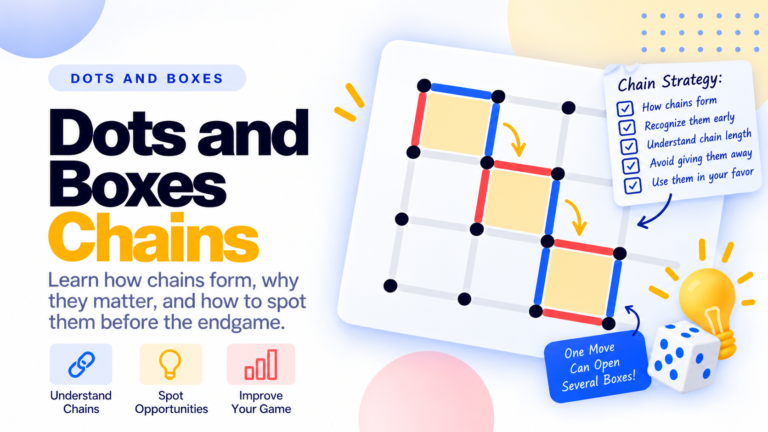
That observation connects opening play to chain formation without requiring you to solve the endgame while the board is still mostly empty.
“Never Draw the Third Side” Needs One Important Qualification
Avoiding the third side is excellent opening advice. It is not a rule that can be followed for the entire game.
Eventually a developed board can reach a position where every remaining non-scoring edge creates a three-sided box somewhere. At that point, a safe move no longer exists.
The strategy therefore changes when the board changes.
While a safe edge exists, creating a third side unnecessarily usually gives the opponent an opportunity you did not have to offer. Once all safe edges are gone, however, “avoid the third side” stops being an actionable instruction because every available route carries a cost.
That transition is where opening strategy ends and component-opening decisions begin. This article deliberately stops there rather than turning the opening into an endgame guide.
Three Opening Shortcuts That Are Too Crude
Dots and Boxes invites simple rules because the board looks regular. Some rules are useful as reminders, but they become misleading when treated as guarantees.
On an empty rectangular board, every legal first edge passes the immediate safety test. The deeper value of an opening line depends on the board size and the moves that follow. A universal “always start here” instruction is therefore too simplistic.
A perimeter line is simpler to inspect because it borders only one box, but that does not make every perimeter move strategically better. Safety still depends on the current side count of the box or boxes the edge touches.
Two sides do not make a box immediately capturable. The danger comes when someone adds the third. Many ordinary safe positions contain two-sided boxes; the important task is tracking which unused edges would convert them into three-sided ones.
The common thread is simple: judge the actual position rather than playing from a visual slogan.
A Reliable Opening Check Before You Draw
You do not need to calculate the whole game from the first turn. A compact inspection routine is enough to eliminate many avoidable opening errors.
Do not draw it yet. First identify every box that shares the edge.
A perimeter edge requires one check. An interior edge normally requires two.
Continue doing this while a genuine safe alternative remains.
Notice where two-sided boxes and connected regions are accumulating instead of treating every safe line as interchangeable.
When step three suddenly fails for every available non-scoring edge, you have learned something important: the opening phase is over. The next move is no longer about finding a harmless line. It is about deciding what you can afford to open.
That habit is more useful than memorizing a favorite first edge. It scales from a small paper grid to a larger board because it is based on the actual state of the boxes around each move.
You can apply the check directly while you play Dots and Boxes online: pause before each early line, inspect both sides of the candidate edge, and make the move only after you know whether it creates a third side.
For the broader relationship between safe opening play, chains, sacrifices, and later phases of the game, see our Dots and Boxes winning strategy.