Dots and Boxes for Kids
Dots and Boxes needs little equipment, takes only a few minutes to learn, and gives children repeated chances to count, notice shapes, explain choices, predict consequences, and test simple strategies.
Give two children a small grid of dots and two pencils. Within a few turns, they are doing more than drawing lines. They are counting completed boxes, watching rows and columns, comparing possible moves, predicting what another player may do, and trying to explain why one choice worked better than another.
That makes Dots and Boxes useful as a short mathematical game at school or at home. It does not require special equipment, and the same basic activity can be made simpler or more demanding by changing the board size and the questions asked around the game.
The goal in a learning setting is not to teach advanced chain theory to every child. Start with a board that can be finished, make the scoring clear, let children play several complete games, and then use their own positions as material for discussion.
What Can Children Practise With Dots and Boxes?
The game naturally creates several kinds of mathematical activity. The value comes from what children are asked to notice and explain while they play.
Children count claimed boxes, check totals, compare scores, and work out how many boxes remain.
Players track horizontal and vertical edges, complete squares, and locate moves within rows and columns.
A child can compare two possible lines and give a reason for preferring one.
Players begin asking what an opponent will be able to do after a particular edge is drawn.
After several games, children can identify board arrangements that often lead to similar consequences.
Pair and team play gives students a reason to describe a move before making it and respond to another person’s reasoning.
These opportunities are strongest when the adult does more than announce the winner. Asking children how they knew, what they noticed, or what they would change in a replay turns an ordinary game into a reasoning task.
Use Small Boards Before Moving to Larger Games
A beginning player needs to see the consequences of a move without tracking dozens of unfinished boxes at once.
Small boards help because the whole position remains visible and a complete game can be played several times in one lesson.
Useful for a first demonstration or for children who are still learning when a square is completed.
A useful starting size for pair play. There is enough room for choices, but the game remains compact.
A natural next step once students can score correctly and think ahead without constant help.
These sizes are practical teaching suggestions rather than age rules. A child who is new to the game may benefit from a smaller grid regardless of age, while an experienced younger player may be ready for a larger board.
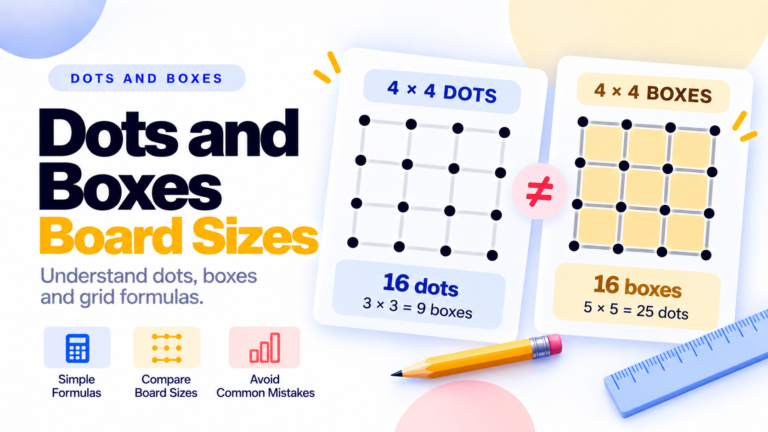
Be precise about the dimensions. A 3 × 3 box board uses 4 × 4 dots. The difference between dot-grid and box-grid naming is explained in our Dots and Boxes board size guide.
A Classroom Session Can Move From Demonstration to Investigation
Dots and Boxes works well when children see one complete example, play for themselves, and then discuss something specific that happened.
Use a 2 × 2 or 3 × 3 box grid. Show legal horizontal and vertical moves, how a box is claimed, and why scoring gives another move.
Give each pair two different pencil colors. Ask them to mark completed boxes clearly so that scoring disagreements are easy to resolve.
Ask students to play again while paying attention to one idea, such as which moves gave an opponent an easy box.
Invite pairs to describe one move that helped, one move they would change, or one pattern they noticed.
The exact timings can vary with the class. The important sequence is see it → play it → replay it → explain it.
If students need a refresher before independent play, direct them to the Dots and Boxes rules rather than using classroom time to introduce advanced strategy.
Ask Questions That Make Children Explain Their Thinking
“Who won?” is useful for checking the final score. It does not reveal much about how the game was understood.
Open questions give students room to describe patterns, make predictions, and defend decisions.
- How many boxes are on this board?
- How many boxes would someone need to win?
- Do you think a tie is possible?
- What might happen after this move?
- Which two moves are you comparing?
- Why did you choose that edge?
- Where did the game change?
- What would you do differently next time?
- Can you convince someone that your idea works?
Questions do not have to be answered instantly. A useful routine is to let the child make a claim, replay a similar position, and see whether the evidence supports the claim.
Three Dots and Boxes Investigations for a Math Lesson
Once students know the basic game, the same board can support short mathematical investigations without changing the standard rules.
A 3 × 3 box board contains 9 boxes. Ask students to try to produce a tied game before discussing whether equal scores are even possible.
Because boxes cannot be split into halves, an odd number of total boxes cannot produce equal final scores in a two-player game.
Keep the same 3 × 3 board. It has 9 total boxes, so the two player scores must always add to 9.
Ask students whether every listed score can actually occur in a legal game. This separates a simple arithmetic possibility from a game-play possibility and gives them something concrete to test.
After a game, each player chooses one earlier move they would like to replace. The pair reconstructs the nearby position and tries a different line.
The aim is not to calculate perfect strategy. It is to connect a decision with a visible consequence and encourage evidence-based reflection.
Make the Activity Easier or Harder Without Replacing It
Different learners can work on the same game while receiving different levels of support.
- Use a smaller board.
- Give each player a different pencil color.
- Let students write initials inside completed boxes immediately.
- Keep a visible running score beside the board.
- Use counters or small tiles to mark claimed boxes if writing inside them is difficult.
- Replay one complete demonstration before pair work begins.
- Move to a slightly larger board.
- Ask students to predict the opponent’s reply before drawing.
- Require a reason before a team agrees on its move.
- Ask for a counterexample to a claimed strategy.
- Compare the same position from both players’ viewpoints.
- Ask students to create and test a conjecture about board size or scoring.
The challenge should come from deeper thinking, not simply from making the grid enormous. A 3 × 3 or 4 × 4 box board can support substantial reasoning when students must explain and justify their choices.
Pair Play and Team Play Encourage Different Kinds of Talk
Standard Dots and Boxes is a two-player game, which makes pair work the simplest classroom format.
Pair play is useful when you want many games happening at once. Each student owns every decision and gets frequent turns.
Two-versus-two play changes the task. Team members must agree on a line before it is drawn. That creates a reason to compare moves aloud.
- More individual decisions
- Faster games
- Easy to organize at stations
- Useful for repeated practice
- Players must discuss a move
- Different strategies become visible
- Students can challenge a teammate’s reasoning
- Useful after the rules are familiar
For team games, one simple classroom rule is useful: the line cannot be drawn until both teammates can state which edge they have chosen. That slows the physical move slightly and creates room for mathematical conversation.
Set Up the Game So the Mathematics Stays Visible
Most classroom problems with Dots and Boxes are not strategic. They come from unclear lines, forgotten scores, or uncertainty about whose box was completed.
This makes the history of the board easier to read and reduces arguments over who drew an edge.
A small initial or colored mark makes the running score visible.
Children should be able to draw one edge without accidentally connecting the wrong pair of dots.
The later part of the game is where many consequences of earlier moves finally become visible.
A focused question usually produces better reasoning than asking children to discover every strategy at once.
Ready-made grids can save setup time. The Dots and Boxes printable page is useful for pair work, stations, homework, or games away from a screen.
At Home, Ask for a Replay Instead of Giving the Strategy Away
Adults often see a child’s mistake before the child does. Correcting every weak move immediately can remove the part of the game that requires prediction.
A more useful approach is to let the game finish and then return to one interesting position.
This keeps the child responsible for the reasoning. The adult can ask, “What do you think happens if we put the line here instead?” rather than supplying the answer.
Once a learner is comfortable with paper play, they can also play Dots and Boxes online and use the same routine: predict a consequence, make the move, and compare the result with the prediction.
Dots and Boxes Classroom Reference
The strongest classroom use of Dots and Boxes is not a worksheet hidden inside a game. It is the game itself followed by a focused mathematical conversation. Children make decisions, see consequences, revise ideas, and have a concrete board in front of them when they explain what they noticed.