Dots and Boxes Endgame Strategy
Late in a game, the important question is no longer which line looks safe. It is who must open the remaining components, who receives them, and whether keeping control is worth the boxes it costs.
Opening mistakes are often local: one careless line gives away a box. Endgame mistakes can be much larger. A single decision about which component to open can determine who receives several boxes in succession.
By the late game, most harmless edges have disappeared. The remaining unclaimed boxes are increasingly organized into connected components such as chains, short fragments, or closed structures. Completing boxes also keeps the same player moving, so the order in which those components are opened matters as much as their size.
This creates two different endgame jobs. One player has to decide what to open. The other has to decide what to take and whether to keep control.
If safe-edge play is still the main problem on your board, start with our Dots and Boxes opening strategy. The endgame begins after that style of decision has largely run out.
When Does the Dots and Boxes Endgame Begin?
There is no need to define the endgame by a fixed move number. A more useful practical boundary is the state of the board.
Early on, players usually have edges they can draw without giving an opponent an immediately capturable box. As those safe choices disappear, the remaining boxes become tied together into components. Eventually, making progress means opening one of those components.
The main task is avoiding unnecessary third sides.
Unclaimed boxes are now increasingly locked into components.
Move order and component choice become central.
Mathematical treatments sometimes study especially clean late positions separately from the messy transition that produced them. In an actual game, however, you do not need a formal label before improving your play. Once every candidate move seems to give something away, stop thinking one edge at a time and inspect the board as a collection of components.
Build an Endgame Map Before Choosing a Line
A useful endgame habit is to freeze the position mentally before drawing anything. Four pieces of information matter immediately.
Boxes already claimed still count. Endgame control does not erase an earlier score advantage.
Compare the remaining boxes with what each player still needs to win.
Separate ordinary chains from short fragments and closed components instead of treating the board as one mass.
The player making the next sacrifice and the player receiving it have different decisions.
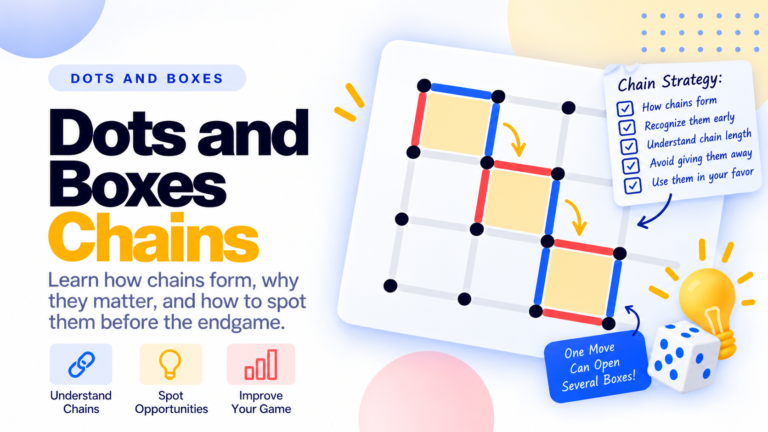
The third step depends on recognizing connected box sequences correctly. Our guide to Dots and Boxes chains covers that structure in detail. Here, the important point is to count components before choosing among them.
Two positions with the same number of unclaimed boxes can behave very differently if those boxes are arranged into different components.
Opener and Controller Make Different Decisions
Endgame analysis becomes clearer when the two roles are separated.
The opener is the player who must make the move that opens a chain or another component. The controller is the other player, who receives that opened component and decides how to handle it.
The opener compares the available components and tries to minimize what the opponent can gain from the forced opening.
The controller decides whether immediate boxes or favorable move order is more valuable.
These are temporary roles, not permanent labels for the two players. If the controller takes an entire component and then has to open the next one, the roles can reverse.
That role reversal is one reason late-game play cannot be reduced to “take every free box.”
Control Is Valuable Because It Changes Who Opens Next
Suppose your opponent opens a long chain to you. One option is to capture every available box. That gives you the largest immediate score from the component.
But your final capture also gives you another move. If another unopened component remains and there is nowhere neutral to play, you may now have to open that next component yourself.
You may become the player who has to open what remains.
The opponent may be left responsible for opening the next component.
The familiar all-but-two sacrifice in a long chain is one way this can happen. The exact move is covered in our double-cross strategy guide; it does not need to be re-taught here.
The important endgame principle is broader: control is a resource, not a score. Keeping it costs boxes. You should pay that cost only when the resulting move order is worth more than what you surrender.
Check the Score Before Chasing Endgame Control
Strategy discussions often isolate the remaining position so that its structure is easier to understand. A real game includes boxes already won.
That existing score can completely change what you need from the endgame.
Player A does not need to maximize the number of remaining boxes. Winning two of the final six produces a 13–12 final score. Player B, by contrast, must claim at least five of those six to reach 13 first.
That difference matters when evaluating sacrifices. A beautiful control sequence that wins more endgame boxes than necessary is still useful, but it is not automatically better than a simpler line that already guarantees the match.
For an odd number of boxes, that means reaching ⌊N ÷ 2⌋ + 1. With an even number of boxes, an equal split can produce a tie.
Track both layers at once: the structure of the remaining components and the number of boxes you actually need.
The Final Component Changes the Value of Control
Control matters because it influences later openings. Once there is no later component, that reason disappears.
Imagine your opponent opens the final long chain on the board to you. There is nothing else left unresolved. Sacrificing boxes to make the opponent move again cannot earn you another chain because no other chain exists.
This is why a control-preserving sacrifice that is useful earlier can become pointless on the last component.
The board itself tells you when to stop paying for future move order: when there is no future move order left to improve.
Mixed Endgames Are Where Simple Rules Start to Break
A tidy position containing only ordinary long chains is easier to reason about than a board containing several different structures.
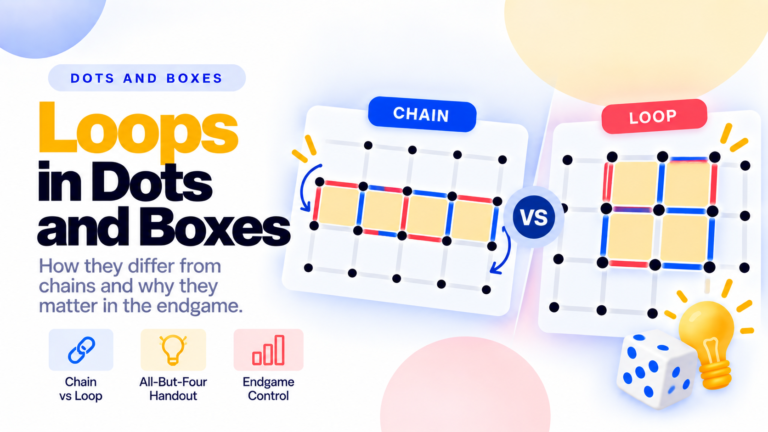
Real games can leave a mixture of long chains, one- or two-box fragments, and closed loops. Those structures do not all respond to the same sacrifice.
A connected chain of at least three boxes. Standard chain-control ideas may apply.
One or two boxes should not automatically be treated as though they were ordinary long chains.
A loop has no ordinary open ends and has different control behavior from a chain.
This is also why merely counting the number of remaining chains cannot solve every endgame. The sizes and types of the components matter, and mixed positions can change the best control decision.
When the board contains structures you have not analyzed yet, the safer approach is to map them separately rather than forcing one memorized chain rule onto the whole position.
A Practical Endgame Decision Tree
When the position becomes forced, work through the board in this order.
If yes, you are not yet forced to open a component. If no, move to the endgame map.
Identify their type and size before choosing among them.
The opener chooses what to expose. The controller chooses how much to take and whether to preserve control.
If another valuable component remains, move order may be worth paying for. If this is the last one, future control has no value.
Compare the endgame plan with the current score rather than optimizing the remaining position in isolation.
Immediate boxes, future control, component type, and match score all belong in the same decision.
This order prevents two common types of endgame error: grabbing boxes before checking what comes next, and applying a control tactic without checking whether control is still valuable.
The fastest way to make the process familiar is to play Dots and Boxes online and pause as soon as the last safe moves disappear. Before drawing the next line, identify the components, current score, and who will be opener and controller.