Loops in Dots and Boxes
A loop is more than a chain bent into a circle. It has no ordinary ends, it changes the cost of keeping control, and it must be read differently when the endgame begins.
A long chain gives you a path with two ends. A loop closes that path back onto itself. That single structural difference changes what happens when the component is opened.
In a standard chain, the familiar control-preserving handout leaves two boxes. In a loop, keeping control requires leaving four. That makes loops more expensive to control and more important to identify correctly before boxes begin to fall.
The distinction matters because a group of nearby boxes can look chain-like on the board while behaving very differently once opened. If the remaining capture route returns to its starting region instead of terminating at ordinary ends, you are dealing with a loop.
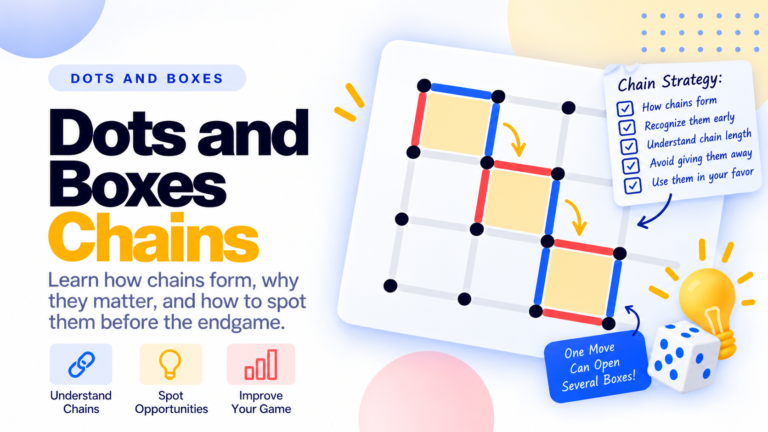
This article focuses on that structure and its practical consequences. For the open-ended component itself, see Dots and Boxes chains.
A Chain Has Ends. A Loop Does Not.
The easiest way to understand a loop is to compare it directly with a chain.
In a chain, the unclaimed boxes form a connected path. If you trace that path from one box to the next, you eventually reach an end.
In a loop, the connected path closes. Continue tracing through neighboring boxes and the route eventually returns to where it began.
The component is a path through connected boxes.
The component closes back onto itself.
The shape does not have to look like a perfect circle. Dots and Boxes is played on a square grid, so loops are built from box-to-box connections and usually have angular shapes.
What matters is topology rather than appearance: the remaining route is closed.
Why Standard Loops Have at Least Four Boxes
In the ordinary rectangular Dots and Boxes grid, a loop cannot contain one, two, or three boxes.
The smallest closed route contains four boxes, producing a 4-loop.
Standard loops on the square grid also have an even number of boxes. A 4-loop, 6-loop, 8-loop, 10-loop, and so on can occur, while an ordinary 5-loop cannot arise from the same square-grid geometry.
This even-length property comes from the geometry of the rectangular grid. Each step through the closed route alternates between the two classes of neighboring boxes, so returning to the starting point requires an even number of steps.
You do not need that mathematical explanation to play well, but the practical result is useful: if you think you have found an ordinary five-box loop on a standard board, inspect the component again.
What Happens When a Loop Is Opened?
A closed loop can remain intact only while nobody is forced to play into it.
When the opener finally draws an edge that breaks the loop’s protected structure, the other player receives access to the component. In the simple loop-and-chain endgames studied mathematically, the exact place where the opener enters the loop does not change the controller’s two basic choices.
The final step is where loops stop behaving like ordinary long chains.
Keeping Control of a Loop Costs Four Boxes
Suppose your opponent opens a 10-loop to you.
If you want the largest immediate score from that component, you can capture all ten boxes. But if another valuable component remains, taking everything may leave you responsible for the next opening.
The control-preserving alternative is the loop version of the hard-hearted handout: take all but four boxes and leave those four for your opponent.
Compare that with a long chain. A control-preserving chain handout leaves two boxes; the loop handout leaves four.
This difference is the most important practical reason to distinguish the two structures. Mistaking a loop for a chain can make you evaluate the price of control incorrectly by two boxes.
The two-box chain version is explained separately in our double-cross strategy. The loop handout should not be treated as the same move with a different-looking board.
An Opened Loop Does Not Mean You Should Always Leave Four
The all-but-four handout is an option, not an obligation.
Once a loop has been opened, the controller has two basic strategic choices.
Gain every box in the component now. If the game continues, you may become the opener for what remains.
Take all but four, give those four away, and leave the opponent responsible for continuing.
The correct choice depends on the rest of the endgame.
In formal loop-and-chain analysis, keeping control is worthwhile when the remaining position is valuable enough to justify the four-box handout. If what remains is worth less than that price, taking the entire loop can be better.
That is deliberately a position-level question rather than a universal rule. The broader process for evaluating remaining components belongs to our Dots and Boxes endgame strategy.
If the Loop Is the Final Component, Take It
The easiest loop decision occurs when nothing else remains.
Your opponent opens the final loop. You can take the entire component and finish the board. There is no later chain or loop whose opening order can be improved.
Take the available boxes. A four-box handout would pay for a future advantage that no longer exists.
This is the same underlying principle that appears throughout control play: sacrifices matter only because they affect what happens next.
Why Loops Do Not Count as Long Chains in the Long Chain Rule
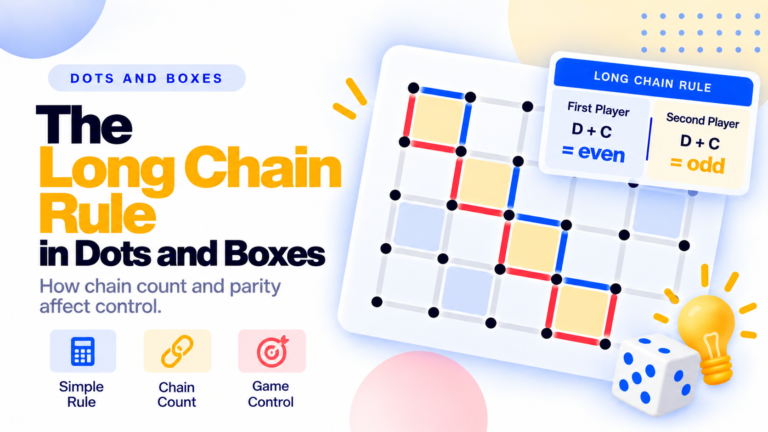
Loops influence the score and the control decisions of an endgame, but the elementary long-chain parity rule does not count each loop as another long chain.
The reason comes from the handout structure.
Preserving control in an ordinary long chain produces one move that completes two boxes at once. The standard loop handout produces two such double-box moves. For parity purposes, adding two does not change whether the total is even or odd.
This is why simply counting “chains plus loops” gives the wrong version of the elementary rule.
The full parity derivation is kept in the long chain rule guide. For loop play, the practical lesson is enough: loops matter greatly to component value without being interchangeable with long chains in that count.
How to Check Whether a Component Is Really a Loop
The safest way to recognize a loop is to ignore the outside shape for a moment and trace the unclaimed boxes through their remaining connections.
Pick any box that appears to belong to the closed structure.
Move from box to neighboring box through the edges that preserve the component.
If the route terminates, you have a chain or another open component rather than a simple loop.
A simple loop returns to the starting region without branching into an ordinary end.
On a standard rectangular board, the count should be even and at least four.
What makes the structure a loop is its closed box-to-box connectivity. A bent or irregular component can still be a loop, while boxes arranged around an empty-looking space may fail to form one if the remaining connections are broken.
Read the Closed Route Before You Count the Boxes
Loops become dangerous when they are mistaken for ordinary chains.
Both structures can release many boxes after being opened, and both can be used in battles over endgame control. But their geometry gives them different costs. A chain has ends and supports the familiar two-box handout. A loop closes on itself and requires a four-box handout when control is preserved.
That means the correct order of thought is:
If you reverse that order and start with the number of boxes, two similarly sized components can look equivalent even though one costs two boxes to control and the other costs four.
You can develop the habit while you play Dots and Boxes online. When safe moves disappear, pause before opening anything and trace each remaining component until you know whether its route terminates or closes.