The Long Chain Rule in Dots and Boxes
The long chain rule connects two simple counts—the dots you started with and the long chains the board is heading toward—to the fight for control. The arithmetic is easy. Knowing when the rule applies is the harder part.
Suppose a 5 × 5 box board is developing toward four long chains. Is four a good number or a bad number? The answer depends on who moved first and, just as importantly, on the number of dots that were on the board before the game began.
This is the idea behind the long chain rule. In the elementary form associated with Elwyn Berlekamp’s analysis of Dots and Boxes, the first player tries to make the number of initial dots plus the number of eventual long chains even. The second player tries to make that sum odd.
That sounds like a prediction rule, but it needs to be used carefully. It is derived from a particular kind of chain-based game in which control is passed through a predictable sequence of long chains. Real positions can contain short components, loops, special chain configurations, and score considerations that require more than one parity count.
So the useful question is not merely “What is the formula?” It is “What does the formula actually tell me, and when am I allowed to trust it?”
What Does the Long Chain Rule Say?
Let:
Here, a long chain means a chain containing at least three boxes. If you need the structural definition before using the formula, see our guide to Dots and Boxes chains.
The word eventual is just as important as “long.” The rule concerns the chain structure the board will resolve into, not simply the number of obvious chains you can see halfway through the game.
Even and Odd Dot Counts Change the Chain Target
You do not need to add the two numbers every turn. Once you know whether the starting number of dots is even or odd, the rule reduces to a simple parity target for the eventual long-chain count.
For example, a 5 × 5 board of boxes is drawn from a 6 × 6 array of dots. That gives 36 starting dots, which is even.
Under the elementary long chain rule, the first player therefore aims for an even number of eventual long chains, while the second player aims for an odd number.
Do Not Confuse Board Size With the Number of Dots
A common source of parity errors is the way board dimensions are described.
A board described as 5 × 5 boxes does not contain 25 dots. It contains 25 boxes arranged between 6 × 6 dots, for a total of 36 dots.
In general, if a rectangular board contains m × n boxes, the dot array contains:
There is also a convenient shortcut when the board dimensions are given in boxes. If both box dimensions are even, then both corresponding dot dimensions are odd, making the total number of dots odd. In every other rectangular case, the number of dots is even.
Why Do Dots and Long Chains Control the Parity?
The long chain rule is not based on a mysterious property of the number three. It comes from counting turns.
If completing a box did not give an extra move, players would simply alternate after every line. Dots and Boxes is different because a scoring move allows the same player to continue.
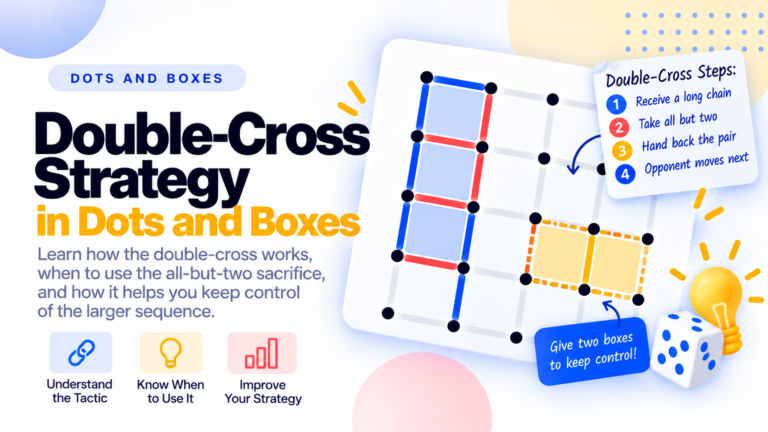
There is one especially important kind of scoring move for this count: a move that completes two boxes at once. Berlekamp’s presentation calls these doublecrossed moves.
In the simple long-chain setting, control is normally maintained by making one such doublecrossed move in every long chain except the final chain. If there are C eventual long chains, that gives:
That relationship is what converts a turn-parity calculation into a long-chain count. The player trying to control the chain phase is really trying to arrange the parity of the eventual turns so that the opponent becomes the player who has to open the first long chain.
The detailed sacrifice used to maintain that control is the subject of the double-cross strategy article. The long chain rule uses the existence of those moves in its count; it does not replace the tactic itself.
Worked Example: Four Eventual Chains on a 5 × 5 Board
Take the standard 5 × 5 box board again. It begins with 36 dots.
Suppose the developing position is expected to resolve into four long chains and, for this simplified example, no other structure disrupts the ordinary long-chain sequence.
An even total matches the first player’s target under the elementary rule. The first player has therefore achieved the parity associated with gaining the favorable side of the simple long-chain phase.
Change just one structural fact. If the position instead resolves into five long chains:
Now the parity matches the second player’s target instead.
This illustrates why splitting or combining developing regions can matter even before boxes start falling. Changing the eventual number of long chains by one flips its parity.
You Are Counting Eventual Chains, Not Just Visible Chains
The arithmetic is easier than forecasting the board.
Halfway through a game, you may see what looks like one large region of unclaimed boxes. That region is not necessarily one finished chain. Later safe moves can split it, reshape it, or prevent part of it from becoming a long chain at all.
This is an important limitation in practical use. The rule can tell you which parity you want, but it does not automatically tell you which current line will produce that parity several moves later.
Stronger chain counting therefore involves prediction. You watch which regions are likely to survive as long chains and which moves can change that future count.
What the Long Chain Rule Does Not Tell You
The elementary rule is powerful precisely because it compresses a complicated part of the game into a parity count. That compression also means information is being left out.
Getting the favorable control parity does not tell you how many boxes each player already owns or the exact final margin.
Knowing the parity you want is different from proving which available edge will produce it.
Component lengths and types can matter even when two positions contain the same number of long chains.
More advanced mathematical analysis is needed for positions involving mixtures of chains and loops or configurations where elementary Nimstring intuition is insufficient.
Modern work on Dots and Boxes endgames goes well beyond parity alone. Positions made entirely from loops and long chains can be analyzed using controlled value and component-specific decision rules, and some configurations involving 3-chains or small loops behave more subtly than the elementary chain count suggests.
That does not make the long chain rule wrong. It tells you what kind of tool it is: a foundational control rule for a useful class of positions, not a complete algorithm for solving Dots and Boxes.
How to Use the Rule During an Actual Game
The most practical use of the long chain rule happens before the chains have fully opened.
First determine your target from the starting board. That part never changes during the game. On a 5 × 5 box board, for example, the initial 36-dot count means the first player wants an even eventual chain count and the second player wants an odd one.
Then watch the developing regions rather than repeatedly counting the dots.
If a move appears likely to turn three eventual long chains into four, that is a parity-changing event. Whether you want that change depends on your target.
But do not force the count at any price. A move that creates your preferred chain parity while immediately giving away decisive boxes can still be bad. Parity belongs inside the larger endgame strategy, alongside component values and the current score.
Once you can recognize developing chains, you can test the idea while you play Dots and Boxes online. Decide your desired parity before the first move, then compare that target with the chain structure that actually emerges.